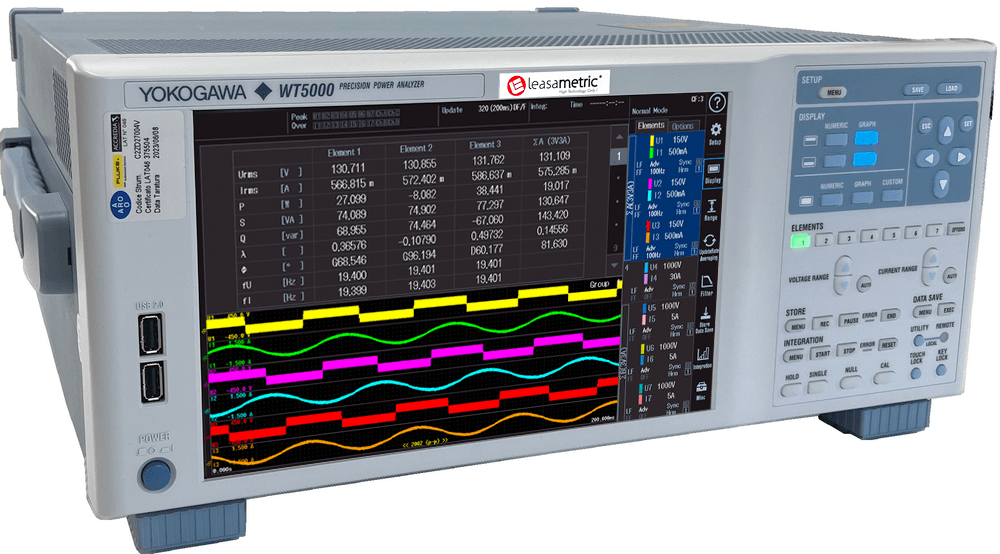
WT5000 Yokogawa
Energy analyzer
High precision electrical energy analyzer, up to 7 channels, USB, LAN, GP-IB remote control.
| RENTAL | 745 € /week* | |||||||
| SALE |
|
|||||||
Specifications : WT5000 Yokogawa
7-channel high-precision energy analyzer :
- Accuracy ± 0.03%,
- 18-bit converter with a sampling rate of 10 MS/s,
- Modular system up to 7 input channels,
- Measurement of currents from 10 µArms up to 30 Arms directly,
- Measurement of voltages from 1.5 Vrms to 1000 Vrms,
- Bandwidth : 5 MHz,
- High definition touch screen,
- Double Harmonic Analysis,
- Memory up to 32 GB internal,
- Mechanical efficiency of up to 4 motors simultaneously (options /MTR1 and /MTR2),
- Fully programmable USB, LAN, GP-IB.
Download the technical documentation WT5000 Yokogawa
To obtain the best measurement precision in the world, the WT5000 uses an 18-bit converter with a sampling rate of 10 MS/s.
It now becomes possible to acquire signals from fast inverters with precision.
Its modular architecture, which accommodates up to 7 input channels, makes it possible to respond to applications that could previously only be measured by synchronizing several instruments. They are particularly useful in the research and development of new energy conversion systems in industry, automotive, aeronautics and research.
Up to 4 electric motors can be characterized simultaneously in a single device with the options /MTR1 and /MTR2. Beyond the mechanical efficiency, the inputs A, B and Z from the torquemeters also make it possible to define the direction of rotation of the motors, to calculate the electrical angle of the synchronous motors as well as the slip (slip) of the asynchronous motors.