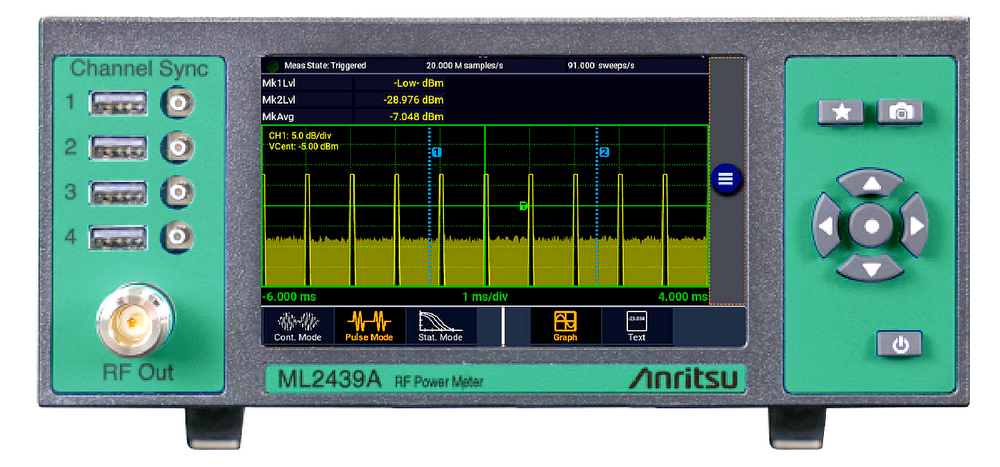
ML2439A Anritsu
Power Meters
Dual / four Input Power Meter, 10 MHz to 50 GHz, GP-IB and LAN interface for Remote monitoring, 5-Inch Multi-touch Display.
| RENTAL | 390 € /week* | ||||
| SALE |
|
||||
Specifications : ML2439A Anritsu
Dual Input Power Meter with comprehensive power measurement capability :
- Adds two active channels (for a total of 4), 0004 Option,
- Frequency Range from 10 MHz to 50 GHz,
- Max Video Bandwidth (VBW) : 195 MHz,
- Min Rise Time : < 3 ns,
- Measurement/Acquisition Speed : 100,000 measurements per second,
- Time Resolution : 100 ps,
- Automatic Pulse Measurements : 16 Max Effective,
- Sample Rate : 10 GS/s Max,
- Pulse Repetition Rate : 50 MHz,
- Supports GP-IB and LAN interface for Remote monitoring,
- Supports SCPI commands over GP-IB and LAN interfaces,
- Optional secure USB drive for additional security,
- Synchronous multi-channel measurements (up to 4 channels),
- 5-Inch Multi-touch Display with Intuitive User Interface,
- HDMI Output for Remote Front Panel Display,
- 4.8 lbs, 2.2 kg Weight.
Download the technical documentation ML2439A Anritsu
The ML2439A power meter has the performance required for narrow, fast rising-edge pulse power measurements (for example, radar).
The ML2439A power meters is designed for CW and modulated signal power measurements, offering a combination of accuracy, speed, and flexibility in a low-cost package.
Several families of power sensors with frequency coverage up to 50 GHz and dynamic range up to 80 dB are available.
Most Anritsu power sensors work in either pulsed/modulated or CW mode.
In choosing a power sensor, several factors must be considered, including frequency range, dynamic range, and modulation type.
The rise time of the sensor should also be chosen to match the rise time of the modulation.